
This threat comes as the assembly of experts in Iran has reportedly reached a majority consensus regarding the successor to the late Supreme Leader Ayatollah Ali Khamenei, according to the Tehran-based Mehr News Agency (MNA).

The United States' historical strategic alignment with Pakistan, dating back to the Cold War, has consistently aimed to create a political and military parity with India, despite India's significantly larger size and resources. This long-standing relationship continues to influence regional dynamics, particularly in West Asia and the Indo-Pacific.

"It is still not too late. India must speak clearly, act responsibly, and use every diplomatic channel available to defuse tensions and promote a return to dialogue in West Asia," Gandhi asserted.

India's handling of the Iran crisis reflects a growing strain between strategic autonomy and geopolitical alignment, observes Ambassador M K Bhadrakumar.

Global energy markets saw a significant correction as oil prices nosedived following Iran's announcement that the Strait of Hormuz has been fully reopened, dismantling the 'war-risk' premium that had gripped the market.

'It would be similar to what happened during COVID-19.' 'They are not just losing income, but being pushed into distress.'

Will rising tensions between US-Israel and Iran threaten crude oil supply through the Strait of Hormuz, putting India's fuel prices, imports, and economic stability at risk?

'In investing, poor sentiment is always a good vintage to build a portfolio.'

The Islamic Revolutionary Guard Corps (IRGC) has announced a series of military operations against US and Israeli targets in retaliation for earlier airstrikes. The IRGC claims to have launched multiple missile and drone strikes, and has warned against any potential ground operations within Iranian territory.

Iran's Islamic Revolutionary Guard Corps (IRGC) claims control of the Strait of Hormuz and reports striking a US destroyer, escalating tensions in the Middle East following retaliatory strikes between Iran, the US, and Israel.

Trump has made it clear: the US will not lift its blockade of Iranian ports until a deal is signed.

'In such a scenario, Iran could proclaim itself victor, rebuild, re-enforce its diminished regional proxies to further destabilise neighbouring nations and take control of the Persian Gulf and Strait of Hormuz.'
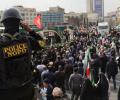
According to information shared with students, those enrolled at Tehran University of Medical Sciences, Iran University of Medical Sciences, and Shahid Beheshti University of Medical Sciences have been offered two evacuation routes -- either through Armenia or Azerbaijan.

Two more Indian-flagged LPG tankers have begun their journey from the Persian Gulf, navigating the Strait of Hormuz amidst regional conflict, following disruptions caused by recent tensions in the Middle East.

The benchmark BSE Sensex's trailing 12-month price-to-earnings (P/E) multiple has declined to 20.2x, its lowest since May 2020, driven by a record $42 billion FPI selloff since September 2024 and concerns over corporate earnings and economic growth.

Bhowneesh Mendiratta leads the Indian shooting contingent at the ISSF Shotgun World Cup in Tangier, Morocco, aiming for a strong start to the season after missing the Paris Olympics. The team faces a tough challenge with experienced and debutant shooters competing.

If Trump wants peace with Iran, Pakistan will offer to help. If Trump seeks Pakistan's aid to spy on Iran, then too Munir will not hesitate to chip in. At the same time, the ISI will not hesitate to tip off Iran now and then, points out M R Narayan Swamy.

Israel and the United States had a plan. Iran punched back. And now the Gulf is reeling, the world is beginning to feel the pain and, as on date, no one in Washington or Tel Aviv appears willing to admit that the punch has landed, notes Prem Panicker, continuing his must-read blog on the war in the Middle East.

'India should understand that we are not going to make the same mistakes with India that we made with China 20 years ago.'

Saudi Arabia and the UAE are actively pushing Trump to take the war to its bitter finish and 'erase' Iran's presence in the geopolitics of the region. Simply put, the two most powerful Sunni Arab oligarchies are on the same page as Israel. Such interference increases the risk of a breakdown in dialogue between the US and Iran, points out Ambassador M K Bhadrakumar.

As days turn into weeks and America loses more planes, as the destruction of trillions of dollars worth military assets piles up, and dead bodies of soldiers return in ever greater numbers in coffins, Trump will have to answer some very difficult questions to save his presidency, notes Ambassador M K Bhadrakumar.

A French soldier was killed while several others were injured in an attack in the Erbil region of Iraq, French President Emmanuel Macron confirmed. Macron, in a post on X, confirmed that Chief Warrant Officer Arnaud Frion of the 7th Battalion of Chasseurs Alpins lost his life in the attack.

'The US landed in this war without planning. The US felt that if they kill Ayatollah Khamenei the people of Iran will come out on the roads and do a regime change.' 'On the contrary, the US bombings on Iran has united the entire nation.'

'We are getting used to the constant alerts to take shelter, listening to sonic booms from jets flying above us, hearing news of neighbouring ports being targeted, and being the only ship in the terminal.'

The government has mandated that cooking gas LPG supply to households will be discontinued if consumers fail to switch to piped natural gas where such connectivity is available, under a new order aimed at accelerating gas network expansion and reducing reliance on a single fuel.

The cost of the war is being counted not in the corridors of power in Washington or Tehran, but in Firozabad's darkened furnace rooms, Howrah's idle casting sheds, and a barbershop in Kochi where the wait is suddenly, inexplicably, an hour long, notes Prem Panicker in his must read blog on the Iran War.

Pakistan is set to host face-to-face talks between the United States and Iran, aiming to solidify a fragile ceasefire and prevent further conflict in West Asia. The discussions will focus on a long-term peace arrangement, including sanctions relief, regional security, and Iran's nuclear program.

Indian hotel companies are experiencing a sharp correction in share prices due to the Iran war and broader geopolitical tensions, leading analysts to cut operating profit expectations and valuations, despite structurally positive medium-term prospects.

Referring to local sources, IRNA shared a video clip that it claims shows the downing of the American F-15 fighter jet in Kuwait.

Iranian news agencies have denied reports of Iranian officials travelling to Pakistan for negotiations with the United States, even as Pakistan prepares for potential talks and faces criticism from Israel.

In a further escalation of the assault on the heavily fortified site, a missile strike also reportedly targeted the "helipad" at the embassy, as documented by Al Jazeera.

India on Saturday said it was deeply concerned over the 'evolving escalation' in West Asia and urged all sides to exercise restraint and return to the path of dialogue and diplomacy.

'The next two to three weeks will not be decided in Washington.' 'They will be decided in Tehran, in whatever calculation Iran makes about the costs of continued resistance against the costs of appearing to have yielded.'
India has issued an advisory for its citizens in Israel to exercise utmost caution and remain vigilant at all times, following a joint attack by Israel and the US against Iran.

Israel wishes to continue its bombing campaign until Iran's military and industrial infrastructure are degraded to a point where it ceases to pose a threat to Israel. Iran, for its part, has learnt from its experience in the 12-day war of last June. Any ceasefire, it believes, will only be a prelude to another attack on itself. It is determined to convey that any attack on Iran will impose heavy costs on Israel, the US, America's allies in the Gulf -- and on the world at large, points out T T Ram Mohan.

'After we were alerted about the war, none of us could sleep for the next two nights while sailing through those waters.'

India-based Iranian actresses Mandana Karimi and Elnaz Norouzi share their deep concerns and anxieties about the escalating crisis in Iran, and reveal the personal toll on their lives and the Iranian diaspora.

India and France have elevated their relationship to a 'special global strategic partnership,' with increased cooperation in defense, trade, and technology. The leaders also inaugurated a helicopter assembly line in Karnataka.

Airports across the country have been placed on operational alert to manage potential flight diversions, unscheduled landings and passenger facilitation requirements.

Chaffing under public ridicule in the US as well as internationally for having 'lost' the war, Trump is under immense pressure to do something, cautions Ambassador M K Bhadrakumar.
